- 人類共通の知的財産/Intellectual Property Common to All Mankind
- 日本語で考える時代/The Age of Thinking in Japanese
- 日本語の独自性と機能性/Uniqueness and functionality of the Japanese language
- 関係構築と経済への影響/Relationship Building and Economic Impact
- 沈黙にも意味がある/Silence has meaning.
- 日本語とAI時代の未来/Japanese Language and the Future in the AI Era
- 新たな価値を創造する/Creating New Value
人類共通の知的財産/Intellectual Property Common to All Mankind

日本語は、その文化的・機能的な独自性から、今や世界的に注目されています。約20年前から日本のポップカルチャーが世界に広がり始めたのを皮切りに、アニメやゲームなどを通じて日本語は自発的・自然に浸透しました。特に近年では、AI技術の発展とともに、日本語が持つ思考力や創造性が再評価されています。多くの専門家や研究者が、日本語を単なる言語ではなく、人類共通の知的遺産として捉え始めています。
Japanese is now attracting global attention due to its unique cultural and functional characteristics. Starting about 20 years ago with the spread of Japanese pop culture around the world, Japanese has spontaneously and naturally permeated through anime, games, and other media. In recent years, with the development of AI technology, the thinking ability and creativity inherent in Japanese have been re-evaluated. Many experts and researchers have begun to see Japanese not merely as a language, but as a common intellectual heritage of humanity.
日本語で考える時代/The Age of Thinking in Japanese
AI研究者や言語学者の間では、いずれ「日本語で考える時代」が来ると予測する声もあります。西洋文明が人類の抱える問題への無力感を覚える中、新たな可能性が模索されているのです。その背景には、日本文化に根ざした思考様式、すなわち「間」や「侘び寂び」といった概念が、行き詰まりを見せる現代社会に新たな視点をもたらすのではないかという期待があるのです。
Among AI researchers and linguists, some predict that an “era of thinking in Japanese” will eventually arrive. As Western civilization recognizes its powerlessness to solve humanity’s problems, new possibilities are being explored. Behind this is the expectation that thought patterns rooted in Japanese culture, such as the concepts of “Ma” (space) and “Wabi-sabi” (beauty in imperfection), may bring a fresh perspective to modern society, which has reached a deadlock.
西洋的な論理や効率性至上主義とは異なる、調和や共生を重視する日本的な価値観が、持続可能な社会の実現に貢献する可能性を秘めていると彼らは感じているのです。さらに、日本語の持つ独特の構造も注目されている。主語の省略や曖昧さを許容する日本語は、多様な解釈を可能にし、創造的な思考を刺激すると考えられているのです。
They feel that Japanese values, which emphasize harmony and coexistence, unlike Western logic and efficiency-first principles, hold the potential to contribute to the realization of a sustainable society. Furthermore, the unique structure of the Japanese language is also attracting attention. It is believed that Japanese, which allows for the omission of subjects and ambiguity, enables diverse interpretations and stimulates creative thinking.
AI研究においては、このような日本語の特性を生かすことで、より柔軟で人間的なAIの開発につながるかもしれない。しかし、「日本語で考える時代」の到来は、単なる幻想ではありません。信頼構築が重要になる現代において、日本語を母語とする我々は、自らの文化を深く理解し、それを世界に向けて発信していく責任があります。それは、西洋文明に対する単なるアンチテーゼではなく、人類全体の未来を考える上で不可欠な視点を提供するものとなるでしょう。
In AI research, leveraging these characteristics of Japanese may lead to the development of more flexible and human-like AI. However, the arrival of an “era of thinking in Japanese” is not just a fantasy. In today’s world where building trust is crucial, we, as native Japanese speakers, have a responsibility to deeply understand our own culture and share it with the world. This is not merely an antithesis to Western civilization but rather provides an essential perspective for considering the future of humanity as a whole.
日本語の独自性と機能性/Uniqueness and functionality of the Japanese language
日本語が持つ独自の機能は、話者の思考や創造性に深く影響しています。
Japanese has unique features that deeply influence the speaker’s thinking and creativity.
1. 複数の文字体系と脳の活性化:日本語は、漢字(表意文字)、ひらがな(表音文字)、カタカナ(記号的文字)という3つの文字体系を同時に使う、世界でも稀な言語です。これにより、日本人の脳は論理を司る左脳と、空間認識や芸術的思考を司る右脳の両方を同時に活性化させると言われています。実際、日本語話者の脳は他言語話者より約15%多くの領域を使用しているという研究もあり、これが日本人の高い知能や認知症発症率の低さに関係している可能性が指摘されています。
1. Japanese is a unique language in the world that uses three writing systems simultaneously: kanji (ideograms), hiragana (phonetic script), and katakana (symbolic script). It is said that this activates both the left brain, which governs logic, and the right brain, which governs spatial recognition and artistic thinking, simultaneously in Japanese people. In fact, some studies have shown that the brains of Japanese speakers use about 15% more areas than those of speakers of other languages, and it has been pointed out that this may be related to the high intelligence of Japanese people and the low incidence of dementia.
2. 豊かな表現力:日本語は、和語・漢語・外来語の3層構造から成り立っており、これらが調和することで無限の表現力を生み出します。また、「サラサラ」「キラキラ」といった擬音語や擬態語(オノマトペ)が非常に豊富で、感情や感覚を繊細に表現する力を持っています。この特性は、細やかさや精密さといった日本文化の精神にも通じています。
2. Richness of Expression: Japanese has a three-layered structure consisting of native Japanese words, Sino-Japanese words, and loanwords, and the harmony of these creates infinite expressive power. In addition, it has a very rich variety of onomatopoeia, such as “sara-sara” (smoothly) and “kira-kira” (sparkling), giving it the power to delicately express emotions and sensations. This characteristic is also related to the spirit of Japanese culture, such as meticulousness and precision.
3. 「間」の美意識と文化的遺産:日本語は、わずか5つの母音からなるシンプルで美しい音体系を持ち、その中に含まれる「間(ま)」の概念は、日本語特有の美意識を象徴します。俳句や短歌といった独自の文学形式も、この音や「間」が不可欠であり、翻訳ではその本質が失われてしまいます。
3. The aesthetic of “Ma” and cultural heritage: The Japanese language has a simple and beautiful sound system consisting of only five vowels, and the concept of “Ma,” which is contained within it, symbolizes the unique Japanese aesthetic. Unique literary forms such as haiku and tanka also rely on this sound and “Ma,” and their essence is lost in translation.
関係構築と経済への影響/Relationship Building and Economic Impact
日本語は、単なる情報伝達のツールではなく、人間関係や経済活動にも影響を与えてきました。
Japanese is not just a tool for conveying information, but it has also influenced human relationships and economic activities.
1. 敬語の力と信頼醸成:日本語の敬語は、相手との距離感を精密に測る高度な言語的ツールです。対立を避け、円滑な人間関係を築くための「関係を築く言語」としての機能を持っています。これはビジネスの場でも、利害の対立を回避し、信頼関係を築く上で重要な役割を果たしています。
1. The power of honorifics and building trust: Japanese honorifics are a sophisticated linguistic tool for precisely measuring the distance between people. They function as a “relationship-building language” for avoiding conflict and building smooth interpersonal relationships. This plays an important role in business settings as well, avoiding conflicts of interest and building trust.
2. 経済発展への寄与:資源に乏しい日本が経済大国となり得た背景には、日本語が日本人の能力を最大限に引き出したという見方があります。「改善(kaizen)」「品質(hinshitsu)」「おもてなし(omotenashi)」といった日本語の概念は、世界共通語となり、世界のビジネス文化に大きな影響を与えてきました。
2. Contribution to economic development: One perspective suggests that the Japanese language played a role in resource-poor Japan’s rise to become an economic power by maximizing the abilities of the Japanese people. Japanese concepts such as “kaizen” (improvement), “hinshitsu” (quality), and “omotenashi” (hospitality) have become global terms and have greatly influenced the world’s business culture.
沈黙にも意味がある/Silence has meaning.
言葉は時に、人を攻撃したり、論争や主張の道具となったりする。しかし、思考を重視する日本語では、対立や分断を避け、沈黙を選ぶ傾向があります。しかし、その沈黙は、必ずしも同意や肯定を意味するわけではない。むしろ、言葉にすることの無意味さ、あるいは言葉では表現しきれない複雑な感情や状況への諦念に近いものです。
Words can sometimes be used to attack people, or as tools for argument and assertion. However, in Japanese, which values thoughtfulness, there is a tendency to avoid confrontation and division, and to choose silence. However, that silence does not necessarily mean agreement or affirmation. Rather, it is closer to a sense of the meaninglessness of putting things into words, or resignation to complex emotions and situations that cannot be fully expressed in words.
言葉を発することによって、かえって真意が歪められたり、誤解を招いたりする恐れがあるならば、あえて沈黙を選ぶ方が賢明だという判断が働く。それは、言葉の限界を知り、言葉を超えたコミュニケーションの可能性を信じる、日本的な知恵の表れとも言えるでしょう。
If uttering words risks distorting one’s true intentions or causing misunderstandings, it is wiser to choose silence. This reflects a Japanese wisdom: knowing the limits of language and believing in the possibility of communication beyond words.
日本語とAI時代の未来/Japanese Language and the Future in the AI Era
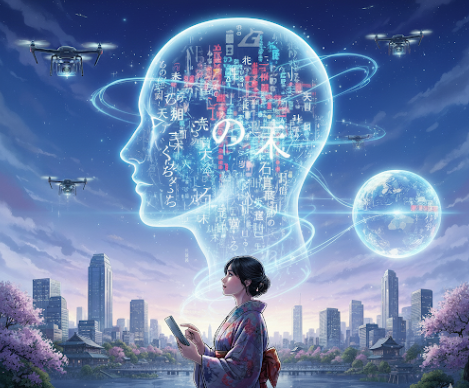
AI技術の進化とともに、日本語は最もAIに適した言語の一つとして評価され始めています。その文脈理解の複雑さ、表記の多様性、感情表現の豊かさは、高度なAI開発に不可欠な要素です。将来的には、日本語をベースにしたAIが世界標準となる可能性も指摘されています。
With the evolution of AI technology, Japanese is beginning to be recognized as one of the languages best suited for AI. The complexity of its contextual understanding, the diversity of its notation, and the richness of its emotional expression are indispensable elements for advanced AI development. In the future, it has been suggested that AI based on Japanese may become the global standard.
このように、日本語は人類の知的遺産であり、未来の文化的・技術的発展に不可欠な資源です。私たち日本人が、自国語の持つ本質的な価値と意義を再認識し、誇りを持つことが、今後ますます重要になるでしょう。
Thus, Japanese is a legacy of human intellect and an indispensable resource for future cultural and technological development. It will become increasingly important for us Japanese people to recognize and take pride in the inherent value and significance of our native language.
新たな価値を創造する/Creating New Value
AIなどの先端技術に加え、日本語と日本文化に根ざした日本人の価値も高まるでしょう。礼儀作法、感性、自然への配慮といった点で、日本人は独自の優位性を持ちます。これらの価値は、信頼関係構築が進む世界において、ますます重要な意味を持つでしょう。多様な文化や価値観が交錯する中で、日本人の持つ調和を重んじる精神や、相手を思いやる心は、国際的な協調を促進する力となるはずです。
In addition to cutting-edge technologies like AI, the values of the Japanese people, rooted in the Japanese language and culture, will also increase in importance. Japanese people have a unique advantage in terms of etiquette, sensitivity, and consideration for nature. These values will become increasingly important in a world where trust-building is progressing. Amidst the intersection of diverse cultures and values, the Japanese spirit of valuing harmony and caring for others will be a force for promoting international cooperation.
また、伝統文化に根ざした美意識や、自然との共生を目指す姿勢は、持続可能な社会の実現に貢献すると期待されます。日本人は、先端技術と伝統文化を融合させ、新たな価値を創造することで、世界に貢献できる可能性を秘めているのです。
Furthermore, its aesthetic sense rooted in traditional culture and its attitude aiming for coexistence with nature are expected to contribute to the realization of a sustainable society. The Japanese have the potential to contribute to the world by fusing cutting-edge technology and traditional culture and creating new value.