Ms. Takaichi and Ms. Meloni
高市首相の圧倒的な存在感/Prime Minister Takaichi’s overwhelming presence
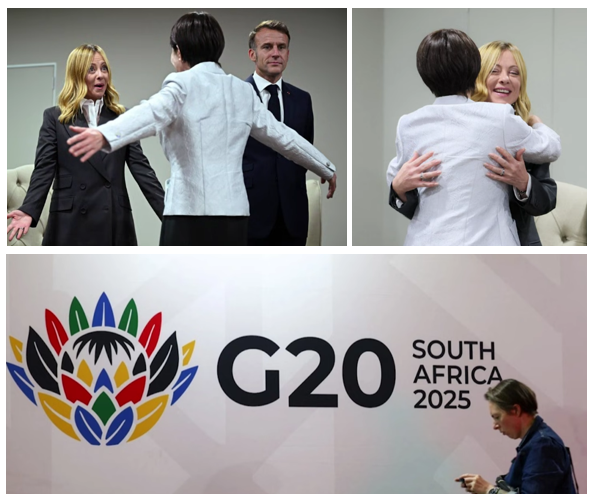
11月22~23日、南アフリカ・ヨハネスブルクで開かれていた主要20カ国・地域首脳会議(G20サミット)。今回、米国が代表を送らなかったため19ヵ国での開催となりました。当初、米中対立が激化する中、サミットの主役は米国と中国と予測されていました。なんと今回のサミットは大方の予想を裏切って、二人の女性代表のハグから始まったのです。ひとりはイタリアの女性首相ジョルジャ・メローニ氏。そしてもう一人が日本初の女性首相高市早苗氏でした。そんな二人の抱擁は一挙に緊張をほぐし、異例の和やかな雰囲気でサミットは開幕されました。
The G20 Summit was held in Johannesburg, South Africa, from November 22nd to 23rd. This time, it was held with 19 countries because the United States did not send a representative. Initially, amid intensifying U.S.-China tensions, the summit’s main players were predicted to be the United States and China. However, contrary to most expectations, this summit began with a hug between two female representatives. One was Italian Prime Minister Giorgia Meloni, and the other was Sanae Takaichi, Japan’s first female Prime Minister. The embrace between the two immediately eased tensions, and the summit opened in an unusually amicable atmosphere.
高市首相は、米国要人の不在が作った空白を自然と埋め、各国首脳の会話の中心に立っていました。高市首相は初日だけで、18人もの各国首脳や国際機関の代表と短く要点を得た実質的な立ち話を交わしました。これは同日中の他国首脳の約2倍にあたります。彼女の他国首脳との会話に費やした合計時間は75分を超え、G20首脳の中で最長でした。また、イタリアのメローニ首相との抱擁は、欧州メディアから「民主主義の連帯を象徴する一瞬」と報じられました。
Prime Minister Takaichi naturally filled the void created by the absence of key U.S. figures, becoming the center of conversation among world leaders. On the first day alone, Prime Minister Takaichi engaged in brief, to-the-point, and substantive discussions with as many as 18 world leaders and representatives of international organizations. This is about twice as many as other national leaders on the same day. The total time she spent in conversation with other national leaders exceeded 75 minutes, the longest among G20 leaders. Furthermore, her embrace with Italian Prime Minister Meloni was reported by European media as “a moment symbolizing the solidarity of democracy.”
韓国メディアは「李在明大統領と高市首相の満面の笑みでの握手は、冷え込んでいた日韓関係が自然に改善に向かっている」と強調しました。外交評論家らは、高市首相が発したのは「言葉ではなく存在感」であり、政治的駆け引きを超えた「人間としての信頼形成」を実践していると分析しています。
Korean media emphasized, “The beaming handshake between President Lee Jae-myung and Prime Minister Takaichi shows that the strained South Korea-Japan relationship is naturally improving.” Diplomatic commentators analyze that Prime Minister Takaichi conveyed “presence rather than words” and is practicing “building trust as a person” that transcends political maneuvering.
中国の沈黙と孤立/China’s silence and isolation
一方、中国の李強首相は、サミット会場で異例の沈黙と孤立の姿勢を見せました。李首相の姿は映像にほとんど映り込まず、各国首脳の輪から明確に距離を取り、集合写真でも端の位置に立つなど、他国との接触が確認されませんでした。
Meanwhile, Chinese Premier Li Qiang displayed an unusual posture of silence and isolation at the summit venue. Premier Li was barely visible in the footage, clearly distancing himself from the circle of leaders from various countries, and standing at the edge in group photos, with no contact with other countries confirmed.
現地報道によると、中国代表団の行動は極めて制限され、李首相は会場内で孤立。他国首脳から最も話したい人物と見られていた高市首相とは対照的でした。外交筋は、李首相が日本との接触を避けるよう北京から指示が出ていた可能性が高いと見ています。これは、台湾問題に関する高市首相の発言の余波で、首脳レベルでの接触が「弱さの象徴」と見なされることを恐れたためだとされています。李首相の沈黙は「恐怖の沈黙」として世界に伝わり、外交の現場で「沈黙は敗北と同義」と見なされました。
According to local reports, the Chinese delegation’s movements were extremely restricted, and Premier Li was isolated within the venue. This was in contrast to Prime Minister Kishida, who was seen by other national leaders as the person they most wanted to speak with. Diplomatic sources believe that Premier Li was likely instructed by Beijing to avoid contact with Japan. This is said to be a consequence of Prime Minister Kishida’s remarks regarding the Taiwan issue, with fears that contact at the leadership level would be seen as a “symbol of weakness.” Premier Li’s silence was conveyed to the world as a “silence of fear,” and in the diplomatic arena, “silence is synonymous with defeat.”
新しい地政学的な構図/New geopolitical landscape
今回のサミットは、名目上のG20ではなく「G19対中国」という新たな構図を浮き彫りにしました。高市首相の周りには、イタリア、韓国、インド、EU代表らが自然と集まり、記者たちはこれを「新しい民主主義軸の誕生」と表現しました。中国はその輪の外に、物理的にも心理的にも遠い位置に立たされていました。
This summit highlighted a new dynamic: “G19 versus China,” rather than the nominal G20. Prime Minister Takachi was naturally surrounded by representatives from Italy, South Korea, India, and the EU, leading journalists to describe it as “the birth of a new axis of democracy.” China stood outside this circle, both physically and psychologically distant.
この非公式の連携は、すぐに実務的な話へと発展し、サプライチェーンの再構築や半導体製造装置の輸出管理など、対中依存の低減を共通のキーワードとしていました。国際メディアの報道比率も日本(31%)が中国(7%)を大きく上回り、開催後の世論調査では、世界の「信頼できる主要国」として日本が初めて米国を上回る(支持率68%)結果となり、中国(17%)との間で「信頼の格差」が明白になりました。
This informal cooperation quickly evolved into practical discussions, with the shared keyword being the reduction of dependence on China, including the restructuring of supply chains and export controls on semiconductor manufacturing equipment. The proportion of international media coverage was also significantly higher for Japan (31%) than for China (7%). Furthermore, in post-summit public opinion polls, Japan surpassed the United States for the first time as the world’s “most reliable major country” (support rate of 68%), revealing a clear “trust gap” with China (17%).
欧州メディアでは、外交の主導権は、軍事力や経済力ではなく「信頼」の有無で決まり、高市首相は「信頼を盾に」世界を動かしたのに対し、中国は「恐怖に支配され」自らの孤立を招いたと総括していました。
European media outlets have concluded that the initiative in diplomacy is determined not by military or economic power, but by the presence or absence of “trust.” They stated that while Prime Minister Takaichi moved the world “shielded by trust,” China, “dominated by fear,” brought about its own isolation.
世界各方面からの反応/Reactions from around the world
G20参加国関係者や各国の報道関係者、および世界のSNS等の反応をランダムに紹介します。
Randomly introducing reactions from G20 member countries, international media, and global SNS platforms.
「(高市首相)力よりも信頼を、威圧よりも秩序を。世界は静かな強さに耳を傾ける時を迎えています」「(インド、モディ首相)あなたの言葉は対立を生まない。それでいて誰よりも明確だ」「(高市首相)政治論争ではなく、未来を共有する政治家の対話」「(アフリカ記者)我々が今必要としているのは、声の大きな国ではない。静かに責任を果たす国だ。だからこそ日本が新しい中心になりえる」「(欧州紙)日本は世界の調整役として世界の中心に戻って来た。日本は信頼を輸出する国だ」「(高市首相)信頼と責任を軸に」「(欧州記者)まるで外交の重力が移動したようだ」
(Prime Minister Takaichi) “More than power, trust; more than coercion, order. The world is entering an era where it listens to quiet strength.” (Prime Minister Modi of India) “Your words do not create conflict. Yet they are clearer than anyone else’s.” (Prime Minister Takaichi) “Not political debate, but dialogue among politicians who share the future.” (African journalist) “What we need now is not a country with a loud voice, but a country that quietly fulfills its responsibilities. That is why Japan can become a new center.” (European paper) “Japan has returned to the center of the world as a global coordinator. Japan is a country that exports trust.” (Prime Minister Takaichi) “With trust and responsibility as the axis.” (European journalist) “It’s as if the gravity of diplomacy has shifted.”
「(南アフリカ紙)李強首相は会場内で孤立。高市首相は他国首脳から最も話したい人物」「(外交関係筋)北京から『日本との接触は避けよと』と指示が出ていた」「(日本外交専門家)高市首相が発したのは言葉ではなく存在感だ。中国は沈黙によって孤立を証明してしまった」「(日本外務省幹部)日韓関係が外交の現場でここまで自然に戻るのは、高市首相の人間的力によるもの」「(日本世論)外交の中心に日本が戻って来た」「(欧州記者)新しい民主主義の軸が誕生した」「(SNS)中国は高市から逃げた」「(SNS)外交は存在感で決まる」「(SNS)G20は外交の通信簿になった」「(SNS)世界は誰の周りに集まり、誰が取り残されるのかを見ている」
(South African paper) “Premier Li Qiang isolated within the venue. Prime Minister Takaichi is the person other countries’ leaders most want to speak with. ” (Diplomatic source) “Instructions came from Beijing to avoid contact with Japan.” (Japanese diplomacy expert) “What Prime Minister Takaichi emitted was not words, but presence. China has proven its isolation through silence.” (Japanese Foreign Ministry official) “The fact that Japan-South Korea relations have returned to this natural state in diplomatic settings is due to Prime Minister Takaichi’s personal charisma.” (Japanese public opinion) “Japan has returned to the center of diplomacy. (European journalist) A new axis of democracy has been born.” (SNS) “China fled from Takaichi.” (SNS) “Diplomacy is determined by presence.” (SNS) “The G20 has become a diplomatic report card.” (SNS) “The world is watching who gathers around whom, and who is left behind.”